
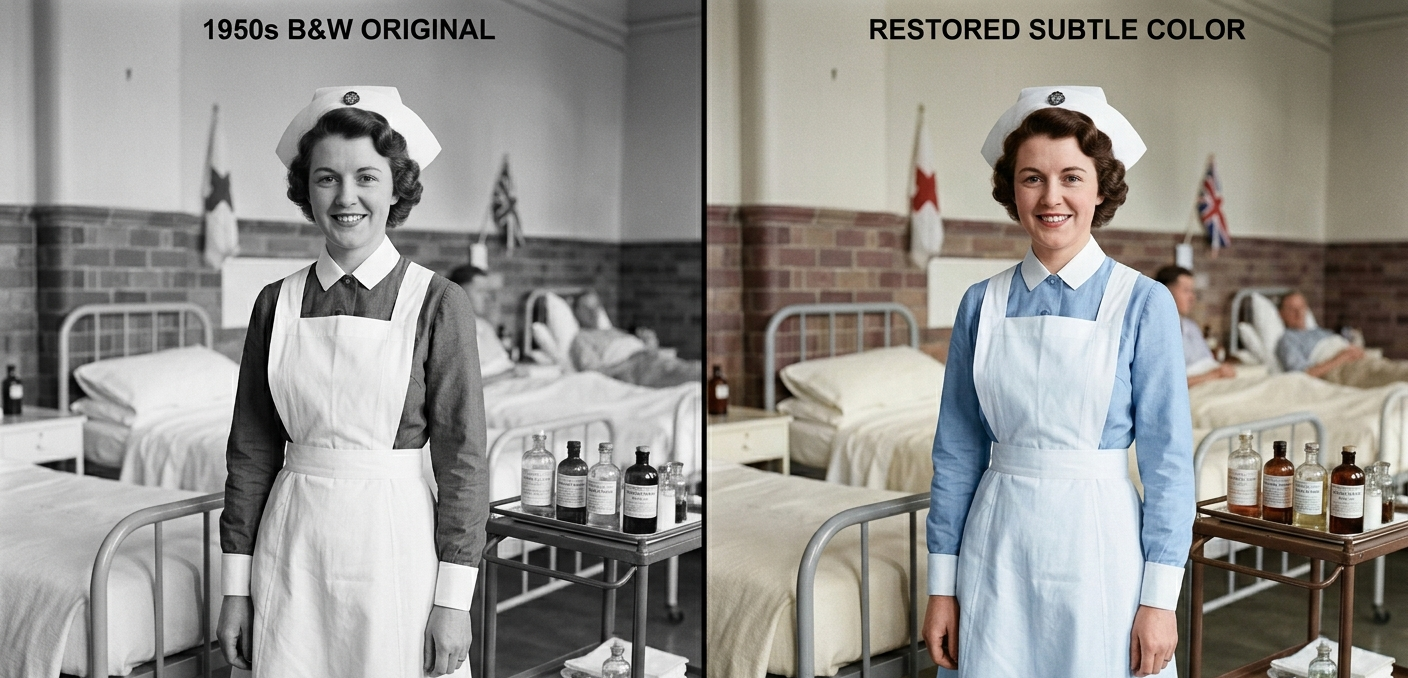
Before the digital age turned everything immediate, before texting and video calls and email — there was the profession that asked everything of a person and rarely offered much recognition in return. The nurse. Starched uniform. Sensible shoes. A composure learned not from ease but from years of holding steady when other people could not.
Somewhere in your family, or in the family of someone you love, there may be a photograph like this. A woman in uniform, standing in a hospital corridor or a ward, looking directly at the camera with the particular self-possession of someone who has seen much and judged little. The photo is likely black and white. It is likely faded at the edges. And it contains, if you look carefully, an entire life.
The Quiet Heroism of Care
We speak often about dramatic heroism — the kind that makes history, that earns monuments and speeches. But there is another kind that operates in silence, on overnight shifts, in the space between a patient’s fear and their recovery. It doesn’t make headlines. It makes people feel less alone at three in the morning.
The nurses of the mid-twentieth century entered their vocation through a kind of formal dedication that the modern world has largely lost. They trained in hospitals, lived in nurses’ homes, wore uniforms that announced their role to everyone in a corridor. Their work was physical and emotional and rarely well compensated. They did it anyway. Many of them did it for decades.
The photograph of a nurse in her ward is not simply a workplace portrait. It is an act of witness — someone thought to capture this person in this moment, doing this work, before time moved on and the hospital changed and the uniform was replaced.
What a Restored Image Can Hold
A black and white photograph keeps its subject at a remove. The colors of the ward walls, the texture of the uniform fabric, the particular warmth or pallor of the light in that hospital — all of this is present but invisible, waiting to be recovered.
When a photograph like this is restored and colorized, something unexpected happens. The nurse becomes a person with a complexion. The uniform becomes a shade of blue or white that speaks to a particular hospital, a particular decade. The ward behind her acquires depth. She ceases to be an archetype and becomes an individual — your grandmother, your great-aunt, a woman whose name you know and whose story deserves to be remembered.
It is not dramatization. It is restoration. You are not inventing anything; you are revealing what was always there.
How It Works: Three Steps to Something Unforgettable
Step 1: Restore and Colorize
Upload the photograph to FotoRipple. The restoration process addresses the physical ravages of time — the yellowing, the spots, the crease lines that cross faces and landscapes alike. Then colorization is applied with care for historical context: the shades of a mid-century hospital, the correct tone for a nurse’s uniform of that era. What was flat and grey becomes dimensional and true.
Step 2: Create Your Clip
The restored image is animated into a short video — not a dramatization, but a gentle awakening. The nurse in the ward seems, for a moment, to breathe. The light shifts slightly. The stillness of a photograph gives way to the faintest sense of presence. This is not special effects; it is the careful work of bringing an image from document to memory.
Step 3: Add Music and Share
A piece of music, chosen for its mood and its reverence, completes the tribute. The finished clip can be shared with other family members, played at a gathering, printed as part of a memorial, or sent quietly to someone who needs to remember that this person’s life mattered. It matters still.
For the People Who Cared
Nurses are not often celebrated with the ceremony they deserve. Their work is considered, perhaps, too practical for poetry. But the people who loved them — and who were cared for by them — know otherwise. They know what it meant to have someone reliable in a moment of crisis. They know the calm that comes from a person who has chosen, every single day, to show up for others.
If you have a photograph of a nurse in your family’s history — or a doctor, a midwife, a care worker, anyone who gave their working life to the service of others — consider what it would mean to restore it. To give it color and motion. To transform it from a faded document into something that moves people as much as she moved through her wards.
That is not a small gift. That is the gift of being seen.
Ready to honor someone whose life deserves to be remembered? Visit www.fotoripple.com and create a tribute that does justice to what they gave.