
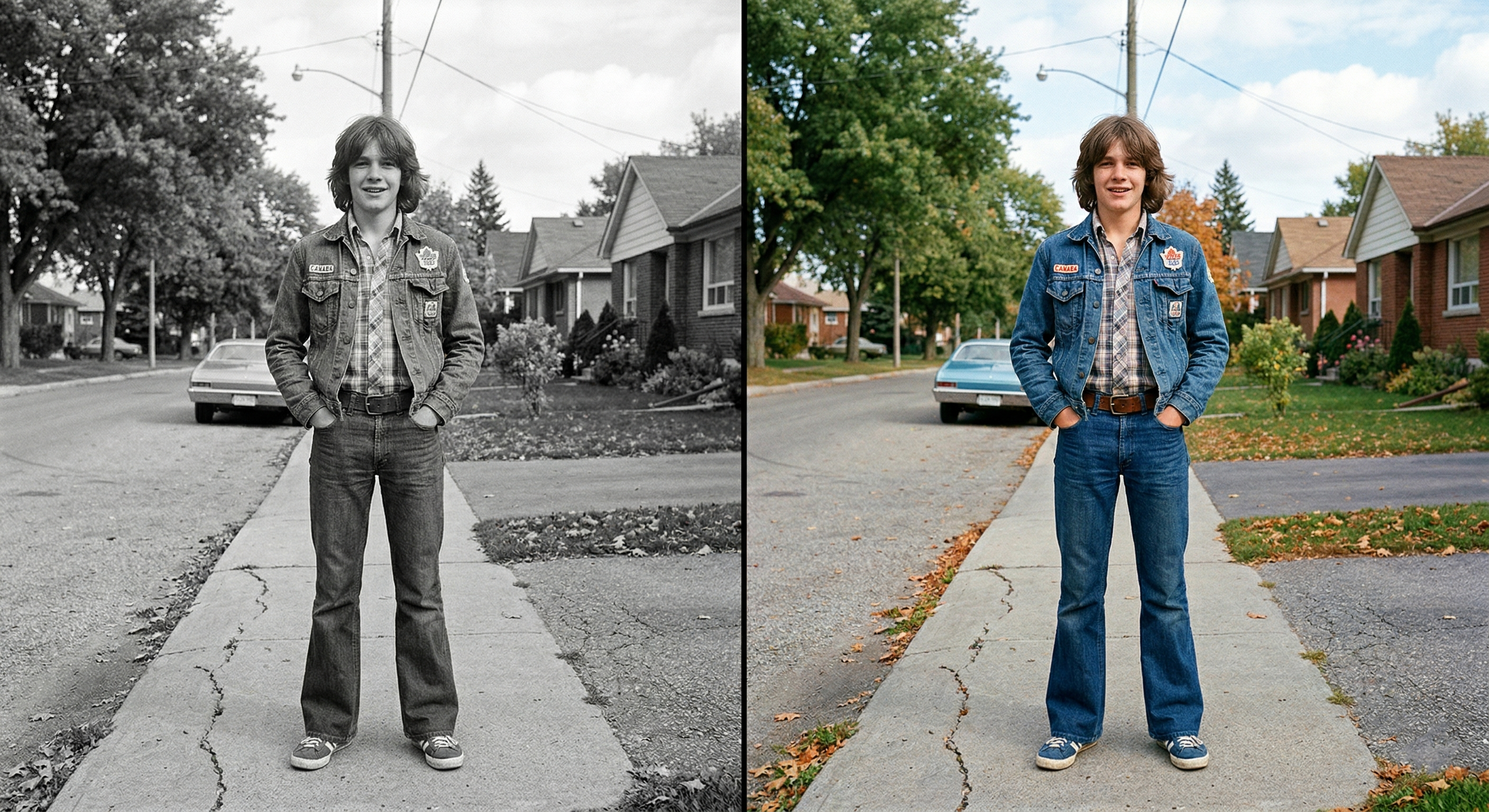
There is a photograph in almost every family’s collection — the one where a teenager stands on a suburban sidewalk, denim jacket buttoned over a thin frame, hands shoved into pockets, squinting against the light. The year is somewhere in the 1970s, though the expression is timeless: equal parts defiance and vulnerability, a person poised at the exact edge of becoming.
You know this photo. Maybe it’s your father as a fifteen-year-old, before the career and the mortgage and the gray at his temples. Maybe it’s your mother, caught between girlhood and the woman she was about to become, her feathered hair lifting slightly in a summer breeze no one else remembers. Maybe it’s you, before you became who you are, standing on a sidewalk in a town that has since changed beyond recognition.
These photographs live at the back of albums, faded and slightly curled, the silver in the emulsion slowly dissolving into something brown and ghostly. We pass them around at family reunions with a kind of reverent amazement — Look how young he was. Look at that jacket. — and then they go back into the box.
They deserve more than the box.
Why That Moment Matters
The teenage years are the years of becoming. Every photograph taken in that window — roughly twelve to nineteen — is a document of a person in transformation, a self being assembled from equal parts hope, embarrassment, music, and borrowed courage. The denim jacket is not just clothing. It is armor. It is a flag. It is a declaration to the world that says: I am here, I am almost ready, please don’t look too closely.
When we look at these photos now, we see the whole arc of a life compressed into a single image. We see what came before the person we know, and we feel something that doesn’t have a clean name — tenderness, maybe, or a kind of grief for the passage of time that isn’t entirely sad.
That feeling is worth preserving. That feeling is worth sharing.
What Fades, and What Doesn’t
Black-and-white film captured the moment, but it surrendered something in the process: the particular blue of a winter sky, the warm brown of the jacket’s denim, the flush in a teenager’s cheeks on a cold afternoon. Those colors existed. The camera simply couldn’t hold them.
Time does the rest. Contrast fades. Edges blur. The photograph becomes a suggestion of a memory rather than the memory itself.
What doesn’t fade is the story. The posture. The expression. The unmistakable fact of a person standing on a sidewalk, alive and uncertain and full of unrealized possibility. That is what FotoRipple works to restore — not just the image, but the life inside it.
Step 1: Restore and Colorize
Upload your photograph to FotoRipple. The restoration process repairs scratches, dust, and the slow deterioration that time inflicts on paper. Then colorization breathes warmth back into the image — the denim gets its blue, the sky gets its depth, and the teenager on the sidewalk becomes a person in a world, not a ghost in a frame.
Step 2: Create Your Clip
Once the photo is restored and colorized, you can transform it into a short, moving video. Subtle animation — a slight shift in the light, a gentle sense of presence — makes the image feel less like a document and more like a memory, the way memories actually feel when they rise up unexpectedly: vivid, close, almost within reach.
Step 3: Add Music and Share
Choose a piece of music that fits the era or the mood. Something from the decade the photo was taken, or something quieter and more timeless. Then share the finished clip — with the person in the photograph, if they’re still here to receive it, or with the family that carries their memory forward.
The teenager on the sidewalk didn’t know anyone was watching history being made. They were just standing in the light, trying to look like they belonged in the world.
Now you can show them that they did.
Visit FotoRipple and give that photograph the life it always deserved.