
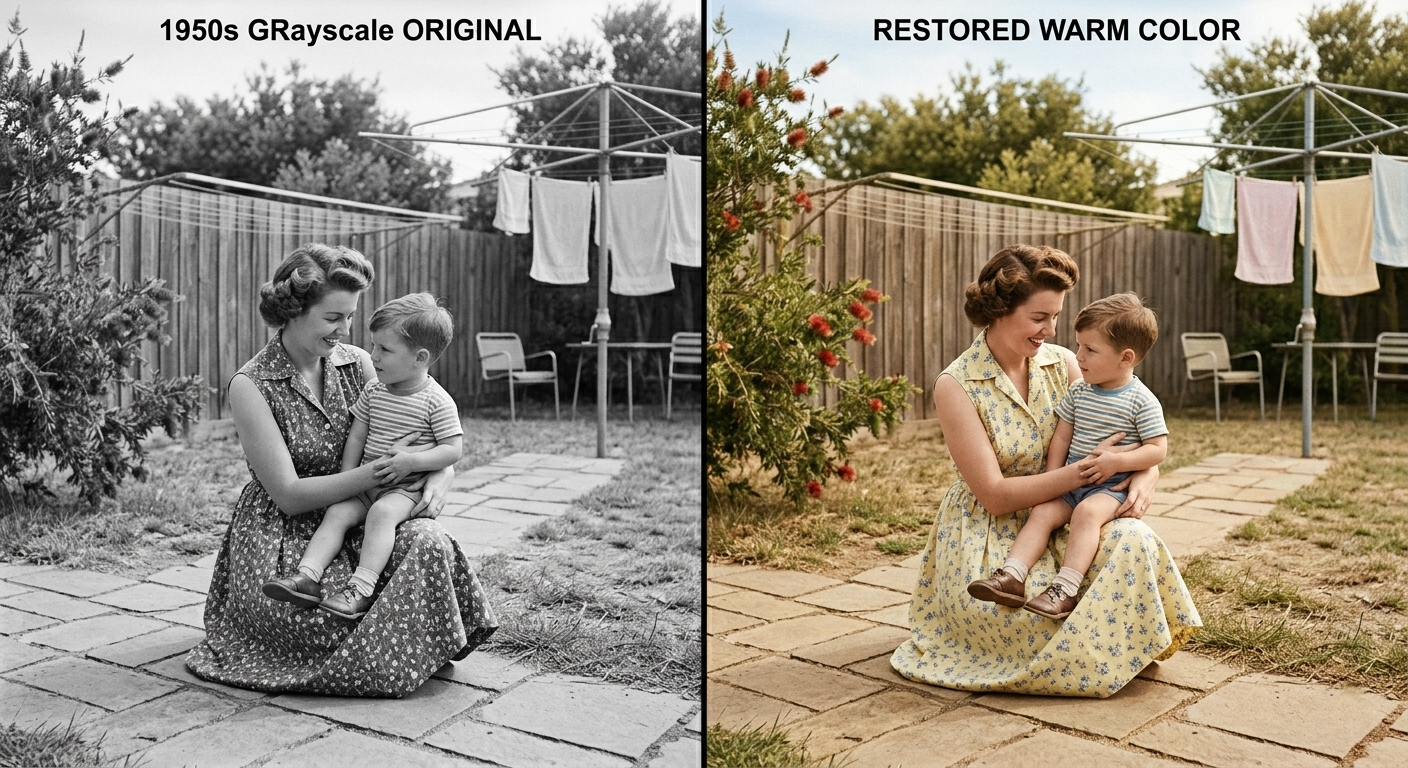
There is a photograph somewhere in almost every family — tucked in the back of a drawer, pressed inside a Bible, or sandwiched between the pages of an album that nobody has opened in years. It shows a woman in a cotton dress, a small child nearby, and in the background, white sheets billowing on a clothesline against a pale sky.
Nothing remarkable is happening. And yet you can’t quite look away.
That is the strange power of the ordinary. The extraordinary moments — the weddings, the graduations, the ceremonial portraits in Sunday clothes — those we expect to move us. But it is the unguarded afternoons, the domestic Tuesdays, the moments nobody thought to frame as significant, that carry the deepest weight of time.
What Lives in a Simple Afternoon
The postwar years had a particular texture to them. There was relief — a collective exhale after years of fear and absence — and with it, a hunger for the small and the stable. A backyard. A child’s laughter. The smell of clean laundry in warm air. These were not modest pleasures; they were the whole point.
A mother hanging sheets while a toddler wobbles nearby isn’t just a domestic scene. It is a world entire. She is young — perhaps younger than you can quite imagine. She doesn’t know what the next decade will bring, or the one after that. She is simply here, in this backyard, on this afternoon, with this child pulling at her skirt.
The photograph caught it. Not a posed smile, not a special occasion. Just the grain of a life being lived.
When Color Returns
Black and white photographs have their own beauty — a timelessness, a gravity. But they also create distance. They remind us, gently but firmly, that the moment belongs to the past. Color does something different. It pulls the moment toward you. Suddenly the cotton dress has a shade. The grass has a particular green. The sky is not abstract anymore; it is the blue of a specific afternoon in a specific year.
When a faded photograph is restored and colorized, something shifts in the viewer. The people in it stop being figures from another era and start being recognizable. Human. Close.
That is not a small thing.
How It Works: Three Steps to Something Unforgettable
Step 1: Restore and Colorize
Begin by uploading the photograph to FotoRipple. The restoration process addresses the damage that time inflicts — the creases, the fading, the soft blur that comes from decades of handling. Then color is carefully applied, not invented, but interpreted from the context of the image: the fashions, the light, the season visible in the frame. What was grey becomes warm and particular.
Step 2: Create Your Clip
The restored image is then animated into a short video — a living, breathing version of what was once frozen in silver and paper. The movement is subtle: a gentle drift, a soft pulse of life. Enough to make you feel, for a moment, that the afternoon is still happening somewhere.
Step 3: Add Music and Share
The final touch is music — a melody that carries the mood of the moment. Something gentle for a quiet backyard afternoon. Something that makes the room go still when you play it. The finished clip can be shared instantly, sent as a gift, played on a screen at a family gathering, or kept as a private treasure.
The Gift That Asks for Nothing
Mother’s Day is the obvious occasion, but this kind of gift doesn’t really need one. A birthday, yes. An anniversary. But also: just because. Just because you found the photograph. Just because she mentioned it once, and you remembered. Just because you want her to see what you see when you look at it — a young woman in a backyard, the whole future still ahead of her, doing something ordinary and entirely beautiful.
The people in old photographs cannot speak. But when you restore and animate them, you do something extraordinary: you give them back a little of the life they actually lived. And you give the people who love them something they didn’t know they were missing.
Ready to bring a family photograph back to life? Visit www.fotoripple.com and create your first animated photo gift today.