
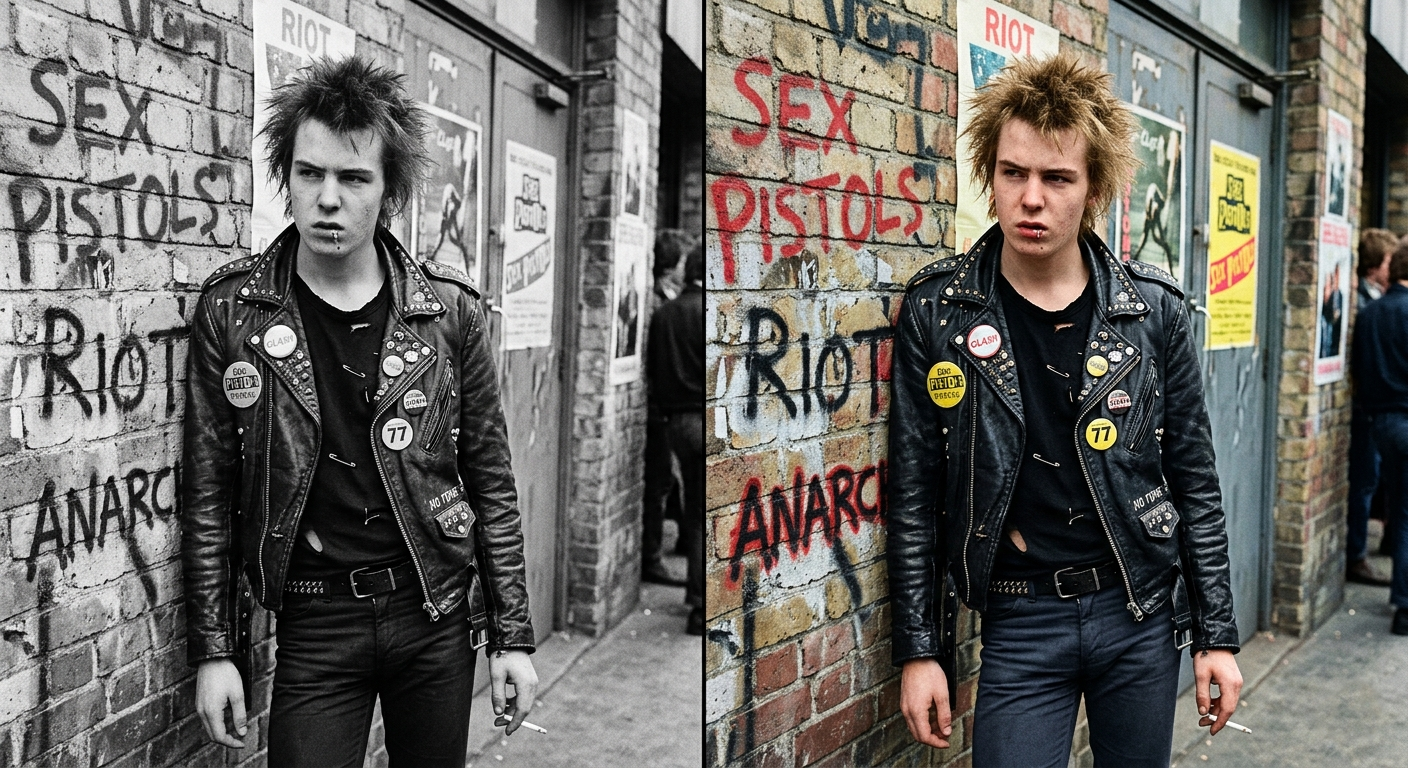
In the photograph, a teenager stands in front of a wall covered in spray paint — Sex Pistols lettering, a dozen other declarations in red and black and green — wearing a leather jacket that carries its own vocabulary. Safety pins at the collar. A hand-drawn patch somewhere near the shoulder. An expression that is not quite a smile and not quite a scowl, something harder to name: the look of a person who has decided, at fifteen or sixteen, that they know exactly who they are and would like the world to catch up. The photograph is black and white, but you can feel the color that was always there. Look closely at that face. That is somebody’s parent. Maybe somebody’s grandparent.
What the Jacket Meant
Punk emerged in Britain in the mid-1970s from a very specific set of circumstances: mass unemployment, political disillusionment, a popular culture that felt remote and unearned, a future that had quietly been cancelled without anyone bothering to announce it. The young people who found their way into punk were not, in the main, nihilists. They were realists who had looked at the world they were inheriting and found the terms unacceptable.
The leather jacket was not just a fashion choice — it was a medium. Where a previous generation might have carried placards or written pamphlets, these teenagers wrote directly on themselves. Every patch was a manifesto. Every safety pin was a modification of the expected, a refusal of the smooth and the sanctioned. The bands they loved — the Sex Pistols, the Clash, the Buzzcocks, dozens of others who never made it past a single — gave them a soundtrack at the exact pitch of their frustration: loud, fast, unsentimental, and shot through with a kind of dark humor that the tabloids consistently missed.
To wear the jacket was to declare allegiance. Not to a party, not to a doctrine, but to the idea that young people from ordinary places with no inherited advantages had the right to take up space, make noise, and say that things could be different.
The Person the Photograph Reveals
There is a particular pleasure in finding a photograph like this in a family archive. It catches the person you know — the one who now makes tea at family gatherings, who has opinions about the garden and the football — at a moment when they were still becoming themselves, still testing the edges of who they might be.
Punk was, among other things, a form of dress rehearsal for adulthood. Its participants were working out, through clothing and music and collective anger, what it meant to have a self worth defending. Many of them look back on that period with a tenderness that surprises outsiders. The music still moves them. The photograph of the jacket still brings something forward in the chest. It was not a phase that passed without leaving a mark — it was a chapter that helped write the person who came after.
When you hold that photograph, you are holding evidence of a becoming. The teenager in front of the spray-painted wall was not lost. They were finding their way home to themselves, loudly and in public, which is the only way anyone ever truly does it.
When Black and White Obscures the Full Story
There is an accidental irony in the fact that so many punk photographs survived in black and white. Punk was one of the most deliberately chromatic movements in the history of youth culture. The colors were chosen with the same aggressiveness as the music: tartan in violent combinations, the red of the Sex Pistols’ lettering, the bleach-yellow of a homemade badge, the greens and pinks of safety pins sourced from sewing baskets and hardware stores. Black and white strips all of that away. It replaces the noise with solemnity. It makes the photograph look like history before history has quite finished happening.
Color restoration gives back what the monochrome removed. The wall behind the teenager comes back with its actual palette — the spray paint in its original reds and blacks, the layers of accumulated declaration that had built up over months of contribution from the neighborhood. The jacket re-acquires its specific shade of well-worn black, the silver of the pins catching flat winter light. The face, lifted out of grey tones, becomes a young face again: particular, present, belonging unmistakably to a specific afternoon in a specific year that someone remembers.
How FotoRipple Works: Three Steps
Step 1: Restore and Colorize
Upload the photograph to FotoRipple. The AI begins with restoration — repairing the creases, the fading, the soft erasure that decades do to paper. Then it returns the color: the historically grounded, visually honest color that was always latent in the image. The leather jacket recovers its depth. The graffiti recovers its original energy. The face recovers its warmth.
No editing experience needed. The result comes back in HD, ready to be seen the way it was always meant to be.
Step 2: Animate into a Cinematic Clip
The restored photograph is brought into motion. Not a dramatic transformation — something subtler and more truthful than that. A slight shift in the quality of the light. The suggestion of breath, of presence, of a moment that is still happening rather than already over. The teenager in front of the wall stops being an artifact and becomes a person again, caught mid-declaration, mid-becoming, fully alive.
Step 3: Add Music and Share
Choose the music that fits the image — something from the era, or something newer that carries the same charge, or something quiet and reflective that honors the distance traveled since. The finished video is ready to share: at a birthday, over a phone call, at the kind of family gathering where old photographs come out and stories attach themselves to faces. Give it to the person who wore the jacket, who may not have seen themselves at that age for twenty or thirty years. Let them hear themselves remembered.
Why Punk Heritage Is Worth Preserving
Every counterculture, in time, becomes part of the culture. The music that scandalized parents in 1977 is now played in supermarkets and used to sell cars. That assimilation is inevitable and, in its way, a tribute: it means the ideas were strong enough to survive domestication. But the personal dimension — the individual act of choosing to stand in front of a wall and declare yourself — that does not get absorbed into the mainstream. It belongs to the person who lived it.
Animating a photograph like this and giving it back to the person who once appeared in it is a specific kind of gift. It says: this version of you was real. This courage was real. The world you pushed back against, the identity you built from scratch out of music and safety pins and borrowed conviction — all of that was real, and it made you who you are now, and it deserves to be remembered with the full weight of color and motion and life.
The teenager in the leather jacket is still in there somewhere. This is a way of saying hello.
Ready to bring a family photograph back to life? Visit www.fotoripple.com to restore, colorize, and animate the image that has been waiting in the dark — and give the gift of a moment remembered in full.