
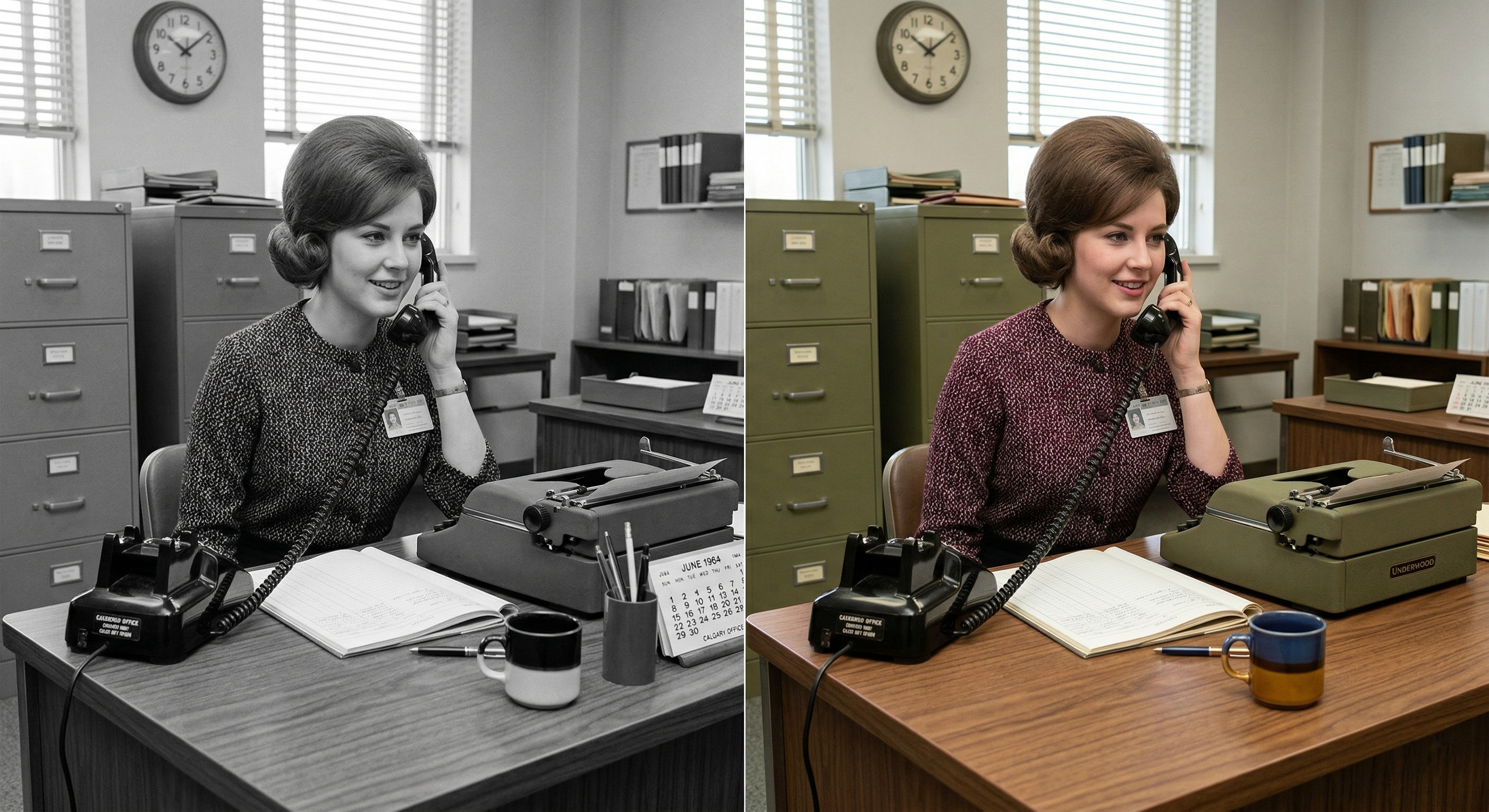
The Voice Before the Inbox
She picked up the receiver before it had finished its second ring. Her voice was warm, precise, unhurried — the first thing anyone heard when they called. She knew every extension, every name, every preference. She knew which managers liked their messages taken in shorthand and which ones preferred a typed note left under a paperweight. She was, in every meaningful sense, the nerve center of the place.
In an era before email flattened the world into identical rectangles of text, the office receptionist was something irreplaceable. She held the threads. She remembered. She made the whole machine run with a kind of invisible competence that nobody quite named and everybody utterly depended upon.
There is a photograph like this in many family albums. A woman at a desk, telephone receiver in hand, a slight smile suggesting she is already three steps ahead of whoever is on the line. The photograph is black and white, perhaps a little faded, the edges soft with age. It was taken on an ordinary Tuesday, sometime between a coffee cup and a deadline, and it caught something true.
That woman may be your grandmother. Your mother. Your aunt. The family friend who eventually ran the whole department. The photograph exists; the moment is sealed inside it. And for a long time, sealed is what it stayed.
What Fading Photographs Carry
Old photographs do not simply record the past. They carry temperature, atmosphere, the specific quality of light in a particular room on a particular afternoon. When we look at them, we do not just see a person — we feel the era pressing in around them. The style of the blouse. The way the telephone cord coils. The in-tray stacked with actual paper. The sense that this woman understood something about dignity and effort that it would be worth learning all over again.
But photographs in black and white, photographs going brittle at the corners, have a way of receding. They become historical rather than personal. The woman in the image begins to feel distant — a figure from another time rather than someone whose hands you once held, whose laugh you can still hear if you concentrate.
Colorization changes that distance. When warm tones return to a face, when the sky-blue of a blouse separates itself from the grey of a filing cabinet behind it, the image steps forward. The woman becomes present again. She is not a relic; she is a person.
Step 1: Restore and Colorize
Begin with the photograph itself. Upload it to FotoRipple and let the restoration tools work on whatever time has done — the scratches, the fading, the loss of detail in the shadows. Then let colorization do its deeper work. The face gains warmth. The desk, the telephone, the small world she commanded each morning, all of it settles into color the way memory actually holds things: not in documentary grey, but in the specific, felt hues of lived experience.
You do not need to know what color her blouse was. The technology reads the image, the era, the light — and it finds something true.
Step 2: Create Your Clip
A still image, even a beautiful one, asks us to hold the moment alone. A clip invites us into it. FotoRipple takes the restored, colorized photograph and breathes subtle motion into it — a gentle animation that makes the image feel inhabited rather than archived. The eyes seem to hold a thought. The posture carries its familiar poise. The photograph stops being a document and becomes, briefly, a presence.
This is the step where family members tend to go quiet when they see it for the first time.
Step 3: Add Music and Share
Choose music that fits the era, or the feeling, or simply the person — something that would have been playing on the radio in the background of her ordinary Tuesdays. Set it beneath the clip. Then share it: at a birthday gathering, at a retirement party held decades late, or simply sent to a sibling who will understand immediately why you made it.
The working women of the past were careful with what they left behind. They did not always tell their stories. But they are in the photographs. They are in the way a hand rests on a telephone receiver, competent and calm and ready.
FotoRipple gives you a way to tell the story for them — to bring the color back, set it in motion, and let the people who loved her see her whole.