
Restore · Military photos
Restore old military photos
A service portrait was often the first professional photograph of a young man or woman's life — and for some families, nearly the last. Restoring one is equal parts photo repair and act of honor.
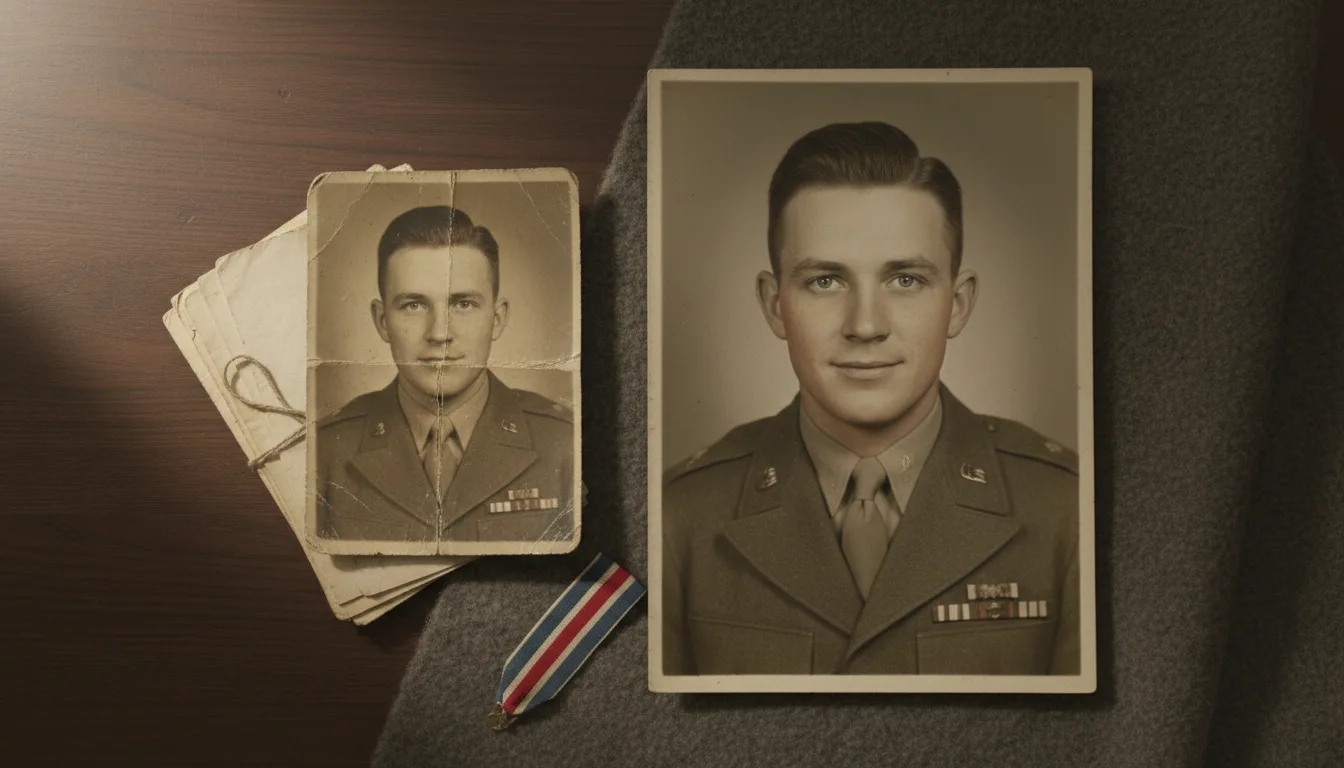
Military photographs — enlistment portraits, unit groups, wartime snapshots, homecomings — age like the paper they're on, but carry weight like little else in the archive. Restoration is free, and handled with the respect the subject demands.
What military photos carry
For many families, the service portrait is a triple document: the record of a person at their youngest adult moment, the marker of the family’s largest sacrifice, and — where letters and medals have scattered — the last physical evidence of the story. When such a photo fades, more than an image dims.
The photos themselves follow patterns. Enlistment portraits: studio-quality, formal, excellent restoration candidates. Unit and group photos: wide, small-faced, where restoration’s detail recovery matters most for identification. Theater snapshots: hastily processed, badly stored, often the most degraded and the most personal. Homecomings: emulsion-era candids with the era’s fading. All restore free; each rewards it differently.
Restoration as remembrance
Families treat this work as an act of honor, and the tooling should too. FotoRipple’s restraint — repair without restyling, color without spectacle, motion (if chosen) without performance — fits the register these photographs demand. For tributes around loss, the memorial video page continues gently from here.
How it works
- 1Digitize the originals carefully — wartime prints are often small and brittle. Scan at high resolution.
- 2Restore free. Fading, creases from wallets and letters, and spotting lift off; insignia and faces sharpen.
- 3Colorize thoughtfully — free. Period-plausible uniform and skin tones; monochrome remains fully honorable.
- 4Share with the family — or further. Reprints for relatives, clips for tributes, images for reunion displays.
Detail matters here
Insignia, ribbons, unit patches — restoration recovers the small details that identify a service story, without inventing any.
Respect is the default register
No stylization, no drama. Whether restored, colorized, or gently animated, the treatment stays as dignified as the portrait.
For veterans and their families
Restored service photos anchor gifts for veteran grandparents, memorial tributes, and family history projects alike.
Example: the wallet portrait
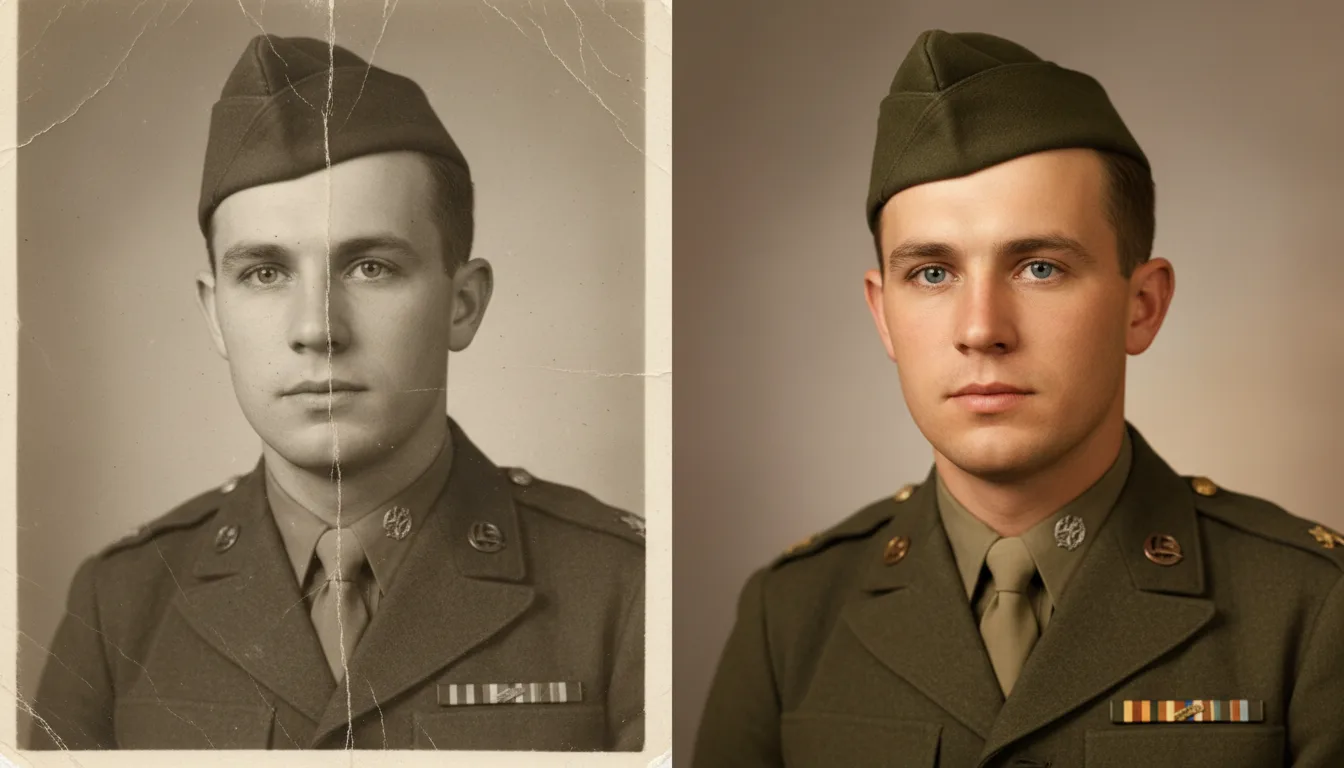
Imagine the photo a great-grandmother carried through the war years: her husband's 1943 enlistment portrait, wallet-sized, soft-cornered, creased down the middle from four years of being folded into letters. Restored, the crease closes and the young face sharpens — twenty-two, serious, unmistakably the man in the 1990s recliner photos. Colorized, the uniform reads correctly. The family prints it beside his discharge papers, and the grandchildren finally see who came home.
Hypothetical composite of a very common restoration.
Tips for the best result
- Scan both sides — censors' stamps, dates, and 'somewhere in the Pacific' notes are history in themselves.
- Ask living veterans to identify unit photos now; names attach to faces only while memory serves.
- For colorization, check uniform details against reference sources or family knowledge before treating results as documentary.
- Pair restored photos with service records for a fuller archive — see genealogy workflows.
- Considering animation? For memorial contexts, read the guidance here first — it's a family-by-family choice.